
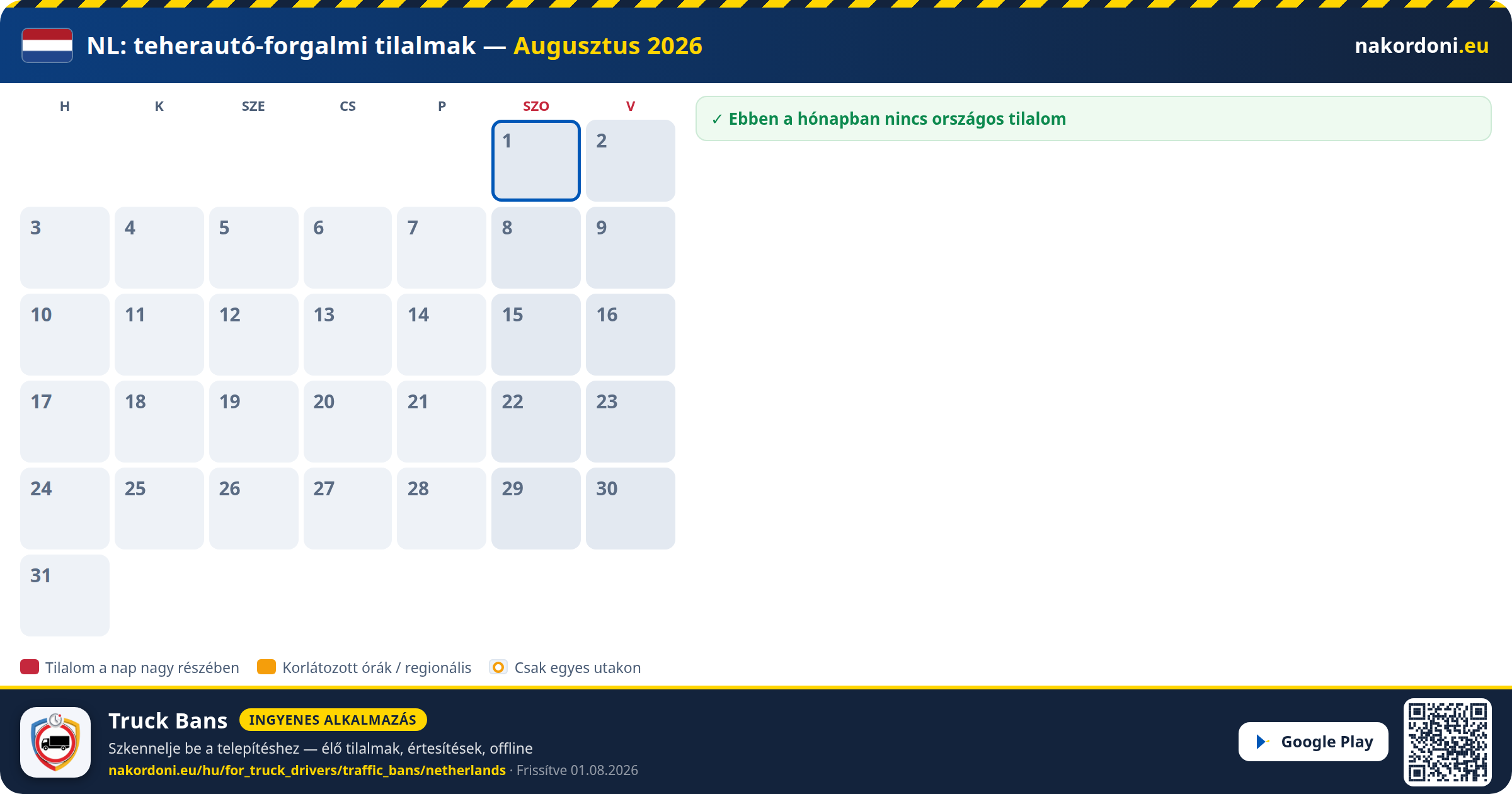
Hollandia: nincs országos teherautó-forgalmi tilalom. Helyi és útvonalspecifikus korlátozások azonban érvényben lehetnek, lásd lent.
Hollandiában nincs országos vasárnapi vagy ünnepnapi kamionos közlekedési tilalom. A teheráru a hét bármely napján közlekedhet az országos úthálózaton. A valódi korlátozások helyiek és környezetvédelmi jellegűek: 2025. január 1-je óta egyre több város üzemeltet zéró-emissziós övezeteket a városi logisztika számára, amelyek kizárják a régebbi dízel kisteherautókat és kamionokat a városközpontjukból, és 2030-ra a rendszer mintegy 28 városra és a Schiphol repülőtérre bővül. A 3,5 t feletti kamionokra ezenkívül 80 km/h sebességkorlát, valamint a szokásos súly- és méretszabályok vonatkoznak.
Következő 30 nap
Hollandia: nincsenek tervezett országos forgalmi tilalmak. A helyi és városi korlátozásokat lentebb ismertetjük.
Ünnepnapok teherautó-tilalmakkal — Hollandia 2026
| Dátum | Ünnep | Tilalom ideje | Hatókör |
|---|---|---|---|
| Újév | Nem vonatkozik általános tilalom | ||
| Nagypéntek | Nem vonatkozik általános tilalom | ||
| Húsvétvasárnap | Nem vonatkozik általános tilalom | ||
| Húsvéthétfő | Nem vonatkozik általános tilalom | ||
| A király napja | Nem vonatkozik általános tilalom | ||
| A felszabadulás napja | Nem vonatkozik általános tilalom | ||
| Mennybemenetel | Nem vonatkozik általános tilalom | ||
| Pünkösdvasárnap | Nem vonatkozik általános tilalom | ||
| Pünkösdhétfő | Nem vonatkozik általános tilalom | ||
| Karácsony | Nem vonatkozik általános tilalom | ||
| Karácsony másnapja | Nem vonatkozik általános tilalom |
A tilalom alól mentes
Környezetvédelmi és zéró-emissziós övezetek
Hollandia nem naptári tilalmakkal, hanem városi behajtási szabályokkal kezeli a kamionforgalmat. 2025. január 1-je óta az önkormányzatok zéró-emissziós övezeteket üzemeltetnek a városi logisztika számára, amelyek a 3,5 t-ig terjedő kisteherautókra és a 3,5 t feletti kamionokra egyaránt kiterjednek. A 2025. január 1-jétől először forgalomba helyezett járművek csak akkor hajthatnak be, ha kibocsátásmentesek. A régebbi dízelek időben korlátozott behajtási joggal rendelkeznek, amely a jármű típusától és az Euro-osztálytól függően 2027 és 2030 között jár le, ezután csak akkumulátoros vagy üzemanyagcellás járművek szállíthatnak az övezetben. Az övezeteket már alkalmazó városok közé tartozik Amszterdam, Rotterdam, Utrecht, Hága, Eindhoven, Groningen, Tilburg, Maastricht, Gouda, Amersfoort és Zwolle, a rendszer pedig 2030-ra mintegy 28 városra és a Schiphol repülőtérre bővül. A külföldön nyilvántartott kamionokat ugyanúgy kezelik, mint a hollandokat, és RDW-felmentésre van szükségük, ha nem felelnek meg a normának.
Alapvető közlekedési szabályok kamionokra
A 3,5 t feletti kamionok az autópályákon és gyorsforgalmi utakon legfeljebb 80 km/h sebességgel haladhatnak, és ahol alacsonyabb korlátozás van kihelyezve, azt be kell tartaniuk. A véralkoholszint-határ 0,5 ezrelék a tapasztalt sofőröknél és 0,2 ezrelék az első öt évben járművezetőknél. Egy tehergépkocsi rakománnyal együtt legfeljebb 50 t lehet, egy pótkocsis tehergépkocsi nem haladhatja meg a 18,75 m-t, egy hosszabb és nehezebb szerelvény pedig csak RDW-engedéllyel érheti el a 25,25 m-t és a 60 t-t. A túlméretes vagy különleges szállításokhoz szintén az RDW előzetes engedélye szükséges.
GYIK
Tilos-e a kamionoknak közlekedni vasárnap Hollandiában?
Nem. Hollandiában nincs törvényes vasárnapi közlekedési tilalom a kamionokra. A teherforgalom minden nap engedélyezett az országos úthálózaton, vasárnap is. Vasárnap főként a kollektív munkaszerződések miatt jár kevesebb kamion, nem közlekedési törvény miatt.
Leállítják-e az ünnepnapok a kamionforgalmat Hollandiában?
Nem. Nincs országos ünnepnapi közlekedési tilalom a kamionokra. Újévkor, húsvétkor, a király napján, mennybemenetelkor, pünkösdkor, karácsonykor és a többi holland ünnepen a kamionok a szokásos módon használhatják az utakat.
Mely holland városok korlátozzák a kamionokat környezetvédelmi övezetekkel?
2025. január 1-je óta a városok zéró-emissziós övezeteket üzemeltetnek a városi logisztika számára, köztük Amszterdam, Rotterdam, Utrecht, Hága, Eindhoven, Groningen, Tilburg, Maastricht, Zwolle, Gouda, Amersfoort és további városok. Ezek az övezetek kizárják a régebbi dízel kisteherautókat és kamionokat a városközpontból, és fokozatosan bevezetik a teljesen elektromos vagy üzemanyagcellás kézbesítést. A program 2030-ra mintegy 28 városra és a Schiphol repülőtérre bővül.
Milyen kibocsátási normára van szüksége a kamionomnak egy holland zéró-emissziós övezethez?
A 2025. január 1-jétől először forgalomba helyezett járműveknek kibocsátásmentesnek kell lenniük a behajtáshoz. A régebbi dízeleknek időben korlátozott a behajtása: a 2017–2019 közötti Euro 6 dobozos teherautóké 2028. január 1-jéig, a 2020–2024 közötti Euro 6 dobozos teherautóké és a 2017–2024 közötti Euro 6 nyergesvontatóké 2030. január 1-jéig. A 2017 előtt gyártott kamionok már ki vannak zárva.
Hollandián keresztül tranzitálok Németország vagy Belgium felé. Befolyásolják-e a terveimet az ottani tilalmak?
Németországban valódi országos tilalom van a 7,5 t feletti kamionokra minden vasárnap és ünnepnapon 00:00–22:00 között, ezenkívül nyári szombati tilalom a felsorolt útvonalakon, ezért ehhez igazítsa a hollandiai indulásokat. Belgiumban nincs általános hétvégi vagy ünnepnapi közlekedési tilalom a szokásos kamionokra. A határátlépés előtt mindig ellenőrizze a célország szabályait.
Milyen alapvető közlekedési szabályok vonatkoznak a kamionokra Hollandiában?
A kamionok sebessége az autópályákon 80 km/h-ra korlátozott, ahol pedig alacsonyabb a kihelyezett korlátozás, ott arra. A véralkoholszint-határ 0,5 ezrelék a tapasztalt sofőröknél és 0,2 ezrelék a jogosítvány megszerzése utáni első öt évben. Egy tehergépkocsi rakománnyal együtt legfeljebb 50 t lehet, egy pótkocsis tehergépkocsi pedig legfeljebb 18,75 m hosszú.
Hivatalos forrás
- Government.nl - Követelmények a tehergépkocsikra
- Government.nl - Teheráru-szállítás
- Business.gov.nl - Zéró-emissziós övezetek Hollandiában
- Op weg naar ZES (kormányzati program) - Hol vannak a zéró-emissziós övezetek
- Rijksoverheid.nl - Hivatalos munkaszüneti napok
- Rijksoverheid.nl - Maximális sebesség az autópályán
- Rijksoverheid.nl - Alkoholhatár a közlekedésben
A szabályok rövid időn belül változhatnak. Indulás előtt ellenőrizze a fenti hivatalos forrásokat.