
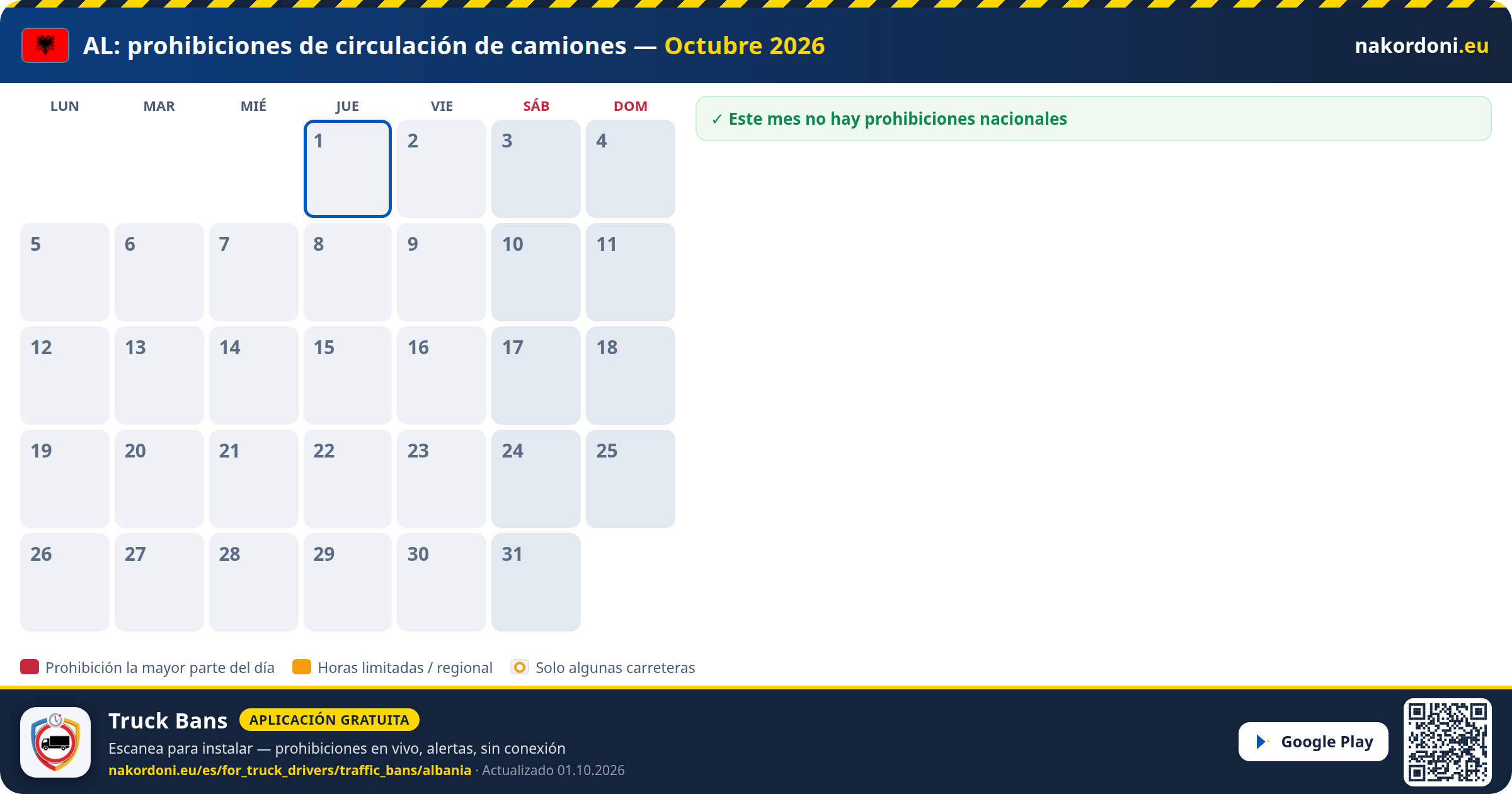
Albania: no hay prohibición nacional de circulación de camiones. Aún pueden aplicarse restricciones locales y de ruta, véase más abajo.
Albania no tiene una prohibición nacional de circulación para camiones: los vehículos de mercancías pueden circular los domingos y días festivos sin una restricción general de calendario. El régimen normativo propio del país se refiere a las mercancías peligrosas (ADR), establecido por la Ley n.º 118 de 2012 y supervisado por el Ministerio de Infraestructura y Energía a través de la Dirección General de Servicios de Transporte por Carretera. La circulación de camiones viene determinada, en cambio, por las normas municipales de acceso, la congestión turística estacional en la costa y las colas en los pasos fronterizos. Los días festivos siguen implicando un tráfico más denso, aunque la circulación en sí sigue siendo legal.
Próximos 30 días
Albania: no hay prohibiciones nacionales de circulación previstas. Las restricciones locales y urbanas se describen a continuación.
Días festivos con prohibiciones para camiones — Albania 2026
| Fecha | Festivo | Horario de prohibición | Alcance |
|---|---|---|---|
| Año Nuevo | No se aplica ninguna prohibición general | ||
| Festivo de Año Nuevo (segundo día) | No se aplica ninguna prohibición general | ||
| Día del Verano | No se aplica ninguna prohibición general | ||
| Eid al-Fitr (Pequeño Bayram) | No se aplica ninguna prohibición general | ||
| Día del Sultán Nevruz | No se aplica ninguna prohibición general | ||
| Pascua católica | No se aplica ninguna prohibición general | ||
| Pascua ortodoxa | No se aplica ninguna prohibición general | ||
| Día del Trabajo | No se aplica ninguna prohibición general | ||
| Eid al-Adha (Gran Bayram) | No se aplica ninguna prohibición general | ||
| Día de la Canonización de la Madre Teresa | No se aplica ninguna prohibición general | ||
| Día de la Independencia (Día de la Bandera) | No se aplica ninguna prohibición general | ||
| Día de la Liberación | No se aplica ninguna prohibición general | ||
| Día Nacional de la Juventud | No se aplica ninguna prohibición general | ||
| Navidad | No se aplica ninguna prohibición general |
Restricciones locales y urbanas
Albania no tiene un calendario nacional de prohibiciones de fin de semana o festivos para camiones, por lo que la planificación de rutas se rige por medidas locales y no por una prohibición nacional. Los municipios pueden restringir el acceso de vehículos pesados a determinadas calles, cascos históricos o zonas según el peso o la hora del día, con señalización local. Tirana y otras ciudades mayores son las más propensas a aplicar tales límites. Al entrar en los centros urbanos, respete la señalización sobre el terreno y los avisos municipales.
ADR y transporte de mercancías peligrosas
El régimen normativo determinante para los camiones en Albania se refiere a las mercancías peligrosas. Albania es parte contratante del acuerdo ADR y lo transpone mediante la Ley n.º 118 de 2012 sobre el transporte de mercancías peligrosas, que establece las normas nacionales e internacionales para el transporte por carretera de cargas peligrosas. La principal autoridad competente es el Ministerio de Infraestructura y Energía, y la supervisión del transporte por carretera corresponde a la Dirección General de Servicios de Transporte por Carretera. Los operadores que transportan mercancías peligrosas deben usar vehículos homologados ADR, poseer certificados ADR de conductor en vigor, designar un consejero de seguridad para el transporte de mercancías peligrosas y llevar el embalaje, etiquetado, marcado y documentación de transporte exigidos. Son estos requisitos, y no las prohibiciones de fin de semana o festivos, el eje del cumplimiento para el transporte a través de Albania.
Normas básicas de conducción para camiones
En Albania se circula por la derecha. Según el Código de Circulación albanés, los vehículos de mercancías de más de 3,5 t están sujetos a límites de velocidad inferiores a los de los turismos: 40 km/h en zonas urbanas, 60 km/h fuera de zonas urbanas, 70 km/h en vías rápidas y 80 km/h en autopistas. Los límites de alcohol son bajos y la policía de tráfico los aplica con rigor, con pruebas en carretera. Lleve consigo toda la documentación del vehículo y del transporte, ya que los controles en carretera son frecuentes en los principales corredores internacionales.
Preguntas frecuentes
¿Están prohibidos los camiones los domingos en Albania?
No. Albania no tiene una prohibición nacional de circulación para camiones los domingos. Los vehículos de mercancías pueden circular cualquier día de la semana sin una restricción general de calendario.
¿Detienen los días festivos el tráfico de camiones en Albania?
No. No existe una prohibición nacional de circulación para camiones en días festivos. Aun así, los festivos traen más tráfico privado y colas más largas en la frontera, por lo que los tiempos de tránsito pueden aumentar, aunque la circulación siga siendo legal.
¿Hay restricciones locales para camiones en las ciudades albanesas?
Sí, en algunos casos. Determinados municipios, incluido el centro de Tirana, pueden limitar el acceso de vehículos pesados a ciertas calles o zonas según el peso o la hora del día mediante señalización local. Son medidas municipales, no una prohibición nacional.
¿Qué normas se aplican al transporte de mercancías peligrosas (ADR) por Albania?
El transporte de mercancías peligrosas se rige por la Ley n.º 118 de 2012 y por el acuerdo ADR, del que Albania es parte contratante. La autoridad competente es el Ministerio de Infraestructura y Energía, que actúa a través de la Dirección General de Servicios de Transporte por Carretera. Los requisitos abarcan el certificado ADR del conductor, un consejero de seguridad, vehículos homologados, embalaje, etiquetado y documentos de transporte.
Transito por Albania hacia un país vecino. ¿Afectan sus prohibiciones a mi plan?
Pueden afectarlo. La propia Albania no impone ninguna prohibición, pero Grecia aplica sus propias restricciones a la circulación de camiones en ciertas rutas y en periodos punta, así que consulte las normas griegas antes de cruzar en Kakavia o Kapshtica. Macedonia del Norte, Kosovo y Montenegro deben consultarse por separado para sus propias restricciones.
¿Qué límites de velocidad se aplican a los camiones en Albania?
Según el Código de Circulación albanés, los vehículos de mercancías de más de 3,5 t están limitados a 40 km/h en zonas urbanas, 60 km/h fuera de zonas urbanas, 70 km/h en vías rápidas y 80 km/h en autopistas. Estos límites son inferiores a los de los turismos.
¿Hay una prohibición estival para camiones en la costa albanesa?
No. No existe una prohibición estacional de circulación. Los corredores costeros hacia Durrës y Vlora soportan un intenso tráfico turístico en verano, lo que ralentiza a los camiones en la práctica, pero ninguna restricción formal detiene el transporte de mercancías.
Fuente oficial
- UNECE ADR, autoridades competentes: Albania (Ministerio de Infraestructura y Energía)
- Transport Community: informe de avance sobre las directrices para el transporte de mercancías peligrosas (Albania)
- Dirección General de Servicios de Transporte por Carretera (DPSHTRR), Ministerio de Infraestructura y Energía
- Código de Circulación de la República de Albania (Kodi Rrugor)
- Panorama de las prohibiciones de circulación para camiones en Europa 2026 (solo a título orientativo, fuente no oficial)
Las normas pueden cambiar con poca antelación. Verifique las fuentes oficiales anteriores antes de salir.